

What’s an inexpensive activity that the whole family can enjoy? How about a walk through Bellingham’s Old Town District? On your journey, you and your family will appreciate our community’s history, natural beauty, and various artistic and architectural achievements.
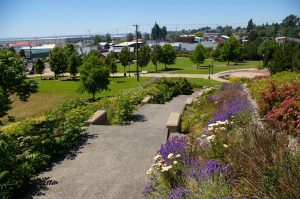
Photo by Theresa Carpine
In the heart of the Old Town District, you’ll find Maritime Heritage Park on Holly Street. A good place to start is near “Convergence” (also referred to as “Confluence” by several sources), a 2001 fountain sculpture installation by Seattle artist Gerard Tsutakawa. Baseball fans might also recognize Tsutakawa’s 1999 sculpture “Mitt” from outside Safeco Field in Seattle. From this landmark, there are numerous sites of Bellingham significance that can be noted without leaving the greater park area.
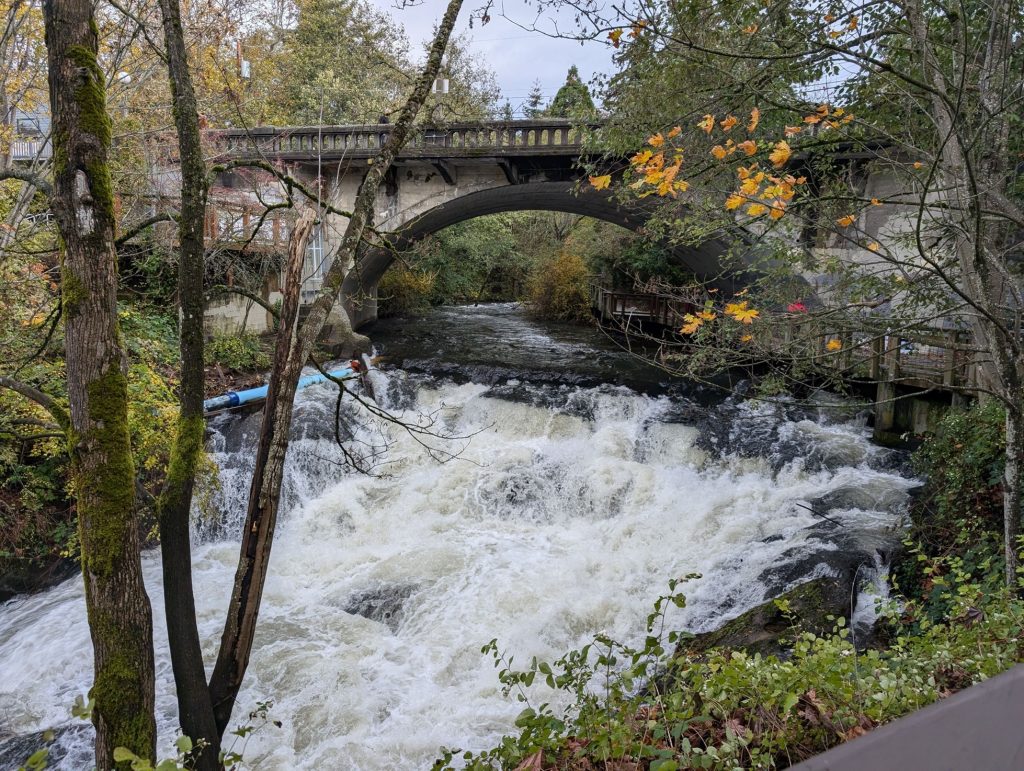
Begin your trip by reflecting on the natural features of the waterfront setting and their connection to our city’s history. Looking west, you’ll see the Bellingham Bay and the San Juan Islands. Just to the north of the sculpture is Whatcom Creek, which seemingly cuts the park into two distinct sections. Historically, the creek provided a vital life link for early tribal residents as they camped in the area and feasted on the fish and other provisions from nature.
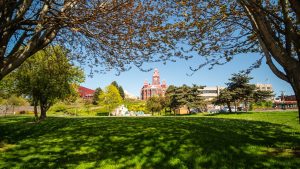
Photo by Theresa Carpine
In 1792, Captain George Vancouver sailed into the bay and bestowed the name of Bellingham to the area; he named the bay after Sir William Bellingham, who oversaw the provisioning of Vancouver’s expedition.
During the 1800s, white settlers arrived from the east. They were initially drawn to Whatcom Creek for fishing; eventually, the power of water for the emerging lumber business was also an appealing factor. These two industries helped turn the settlement into a community, and later, a city.
Across the street from the sculpture is a marker that indicates the dividing line between the early settlements of Sehome and Whatcom. These markers, also found along the South Bay Trail, are part of our greater local history when the towns of Fairhaven, Sehome, Bellingham, and Whatcom united to form what we now know as Bellingham in 1904.
Photo by Theresa Carpine
Several architectural elements in the area reflect the early days of Bellingham. Before moving on for the rest of your tour, turn east to observe Old City Hall, built in 1892. The Late Victorian-style building is now one of three buildings that comprise the Whatcom Museum. You’ll see another museum building next door, the Syre Education Center, which was built in 1926 as the city’s fire station.
Facing west again, another noteworthy structure is the Waterfront Tavern, which celebrates its 100th anniversary in 2010. It is one of the few remaining wharf businesses built on pilings above the water. This building provides a reminder of how much the Bellingham Bay shoreline has changed throughout the years.
To see just how much it’s changed, check out the wall outside Rocket Donuts at Bay and Holly Street to see “Old Town Mural” by Lanny Little, which shows the local artist’s rendering of the area in 1906.
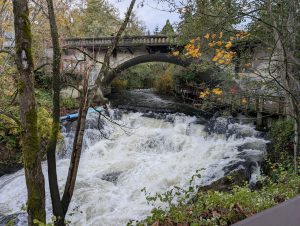
Photo by Theresa Carpine
To the southwest, you can get a look at the old Georgia Pacific site. Its current state of transition provides further understanding of the shift in our area’s dependence on the wood products industry over the years. This also provides a great view into the potential future of the waterfront area and our greater community.
A short walk north out of the park on the Old Village Trail leads to the Whatcom Territorial Courthouse on Astor Street. Like many other buildings in the area, this structure was originally on stilts over the shifting shoreline of the bay. Constructed in 1858, the Territorial Courthouse is the oldest known brick building in the Washington Territory.
Continue a few blocks on the trail and you’ll reach the Pickett House at 910 Bancroft Street. Built in 1856, making it the oldest building in Bellingham, this was the home of Captain George E. Pickett. Pickett was the commanding officer of Fort Bellingham, and a historical marker at Pickett Bridge over Whatcom Creek at Dupont Street notes his leadership during the bridge’s construction in 1857.
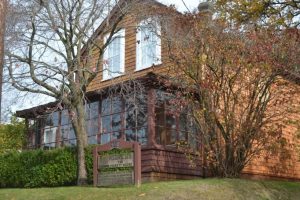
Photo by Theresa Carpine
Pickett lived in Bellingham until 1861 when he returned east for the Civil War. His moniker lives on in military infamy as the namesake of Pickett’s Charge, an unsuccessful infantry assault during the last day of the Battle of Gettysburg.
If you’re up for a bit more walking, you can continue along the Old Village Trail to Elizabeth Park, the oldest park in the city system. Along the trail is a mix of historic homes, churches and businesses, as well as newer structures.
By the end of your journey, your kids will have a lot to digest, both in appreciation of our community’s unique locale by the water and its ongoing history.
What are some of your favorite features of Bellingham’s Old Town District? Please leave a comment below.
